
Securing the future of wheat in Canada
Breeding Innovation
Producers are holding the key to the future of wheat plant breeding
Agriculture and Agri-Food Canada (AAFC) represents the largest wheat breeding program in Canada. On average, 80 per cent of all wheat fields in Canada are planted with AAFC varieties every year. However, changes to AAFC’s wheat breeding programs over the past two decades and recently announced budget cuts threaten the sustainability, efficiency and effectiveness of AAFC programs moving forward.
The Canadian Wheat Research Coalition (CWRC) engaged Synthesis Agri-Food Network to review Canada’s wheat breeding innovation system to safeguard its ability to serve the evolving needs of Canadian farmers. The review featured a comprehensive analysis of related reports and studies, as well as interviews with 29 key stakeholders.
This process confirmed three crucial facts about the current wheat breeding landscape in Western Canada:
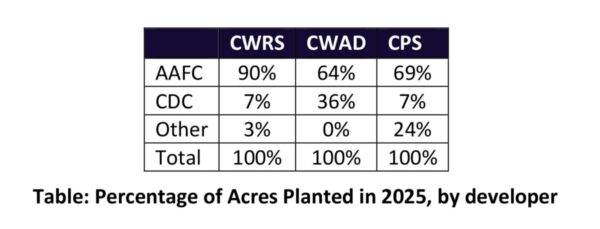
1. The AAFC wheat breeding program is an integral part of western Canadian wheat variety development.
AAFC represent the largest breeding program in Canada. On average, 80% of all wheat fields in Canada are planted with an AAFC variety every year.
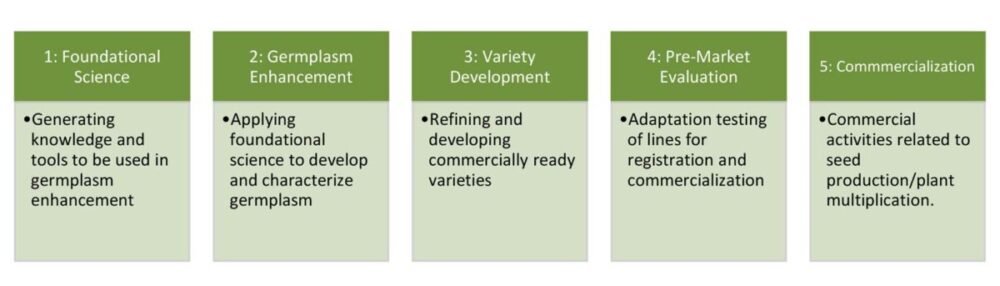
2. The current wheat breeding system is at risk from recent and historic budget cuts, especially at the variety development and pre-market evaluation stages.
Wheat breeding is a complex and iterative process. To effectively analyze an innovation system so complex, the CWRC has examined the Canadian system along each stage of the Plant Genetics Improvement Continuum:
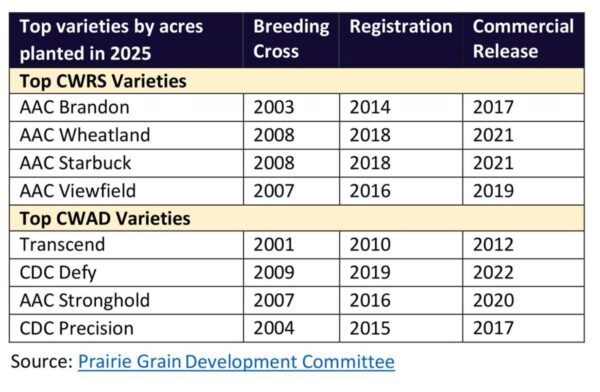
3. Wheat breeding is a long-term process and decisions made today will impact agriculture decades into the future
Plant breeding is an inherently long-term activity. The top CWRS and CWAD varieties by acreage planted in 2025 are the result of initial breeding crosses made between 2001 and 2009. There is an average of 13 years from initial cross to commercial release. Using these averages, breeding crosses made today will be released in 2037. While advanced breeding technologies may speed up the process, breeding is still a long-term activity.
The CWRC is currently exploring options to transform Canada’s wheat breeding innovation system. Discussions are underway with AAFC and the CWRC is committed to engaging all stakeholders throughout the process
Next Steps
A New Vision for Wheat and Barley Breeding for Western Canada
The CWRC invited stakeholders directly engaged in wheat and barley plant breeding in Western Canada to gather in Winnipeg, MB, to co-develop a shared vision of the optimal future of western Canadian wheat and barley plant breeding.
All participants agree on the following shared vision for the future:
The western Canadian wheat and barley plant breeding system is thriving and innovation driven, where collaboration and competition coexist to attract diverse investment and provide farmers with choice in superior, field-ready varieties that meet the needs of our end use customers.
The optimal wheat and barley plant breeding system will:
- Deliver Superior Field-Ready Varieties
Deliver superior field-ready varieties that provide choice to support the market and meet the needs of end use customers. - Technology Driven Innovation
Have the capacity to integrate the most advanced breeding technologies, testing/screening methods and data science to enable efficient delivery of improved varieties. - Leverages Farmer Investments
Recognizes and leverages the long-term investments made by farmers. - Enables Competition & Collaboration
Enables competition and collaboration to drive innovation and farmer choice. - Provides Stable Long-Term Investment
Provides reliable, long-term public and private investment in plant breeding programs. - Enables a Return on Investment
Have the capacity to deliver a sustainable return on investment (ROI). - Attracts Investment & Talent
Attracts investment and talent into the Canadian plant breeding system from both domestic and global sources. - Connected Across the Plant Genetics Improvement Continuum
Connected with strong feedback loops and collaboration focused on delivering measurable results for farmers. - Supportive Regulatory & Commercialization System
Supported by a regulatory and commercialization system that is responsive to the needs of farmers and end users.

CWRC and CBRC join forces to transform wheat and barley breeding
On Sept. 3, 2026, the CWRC and CBRC announced a formal, strategic partnership to transform the Canadian wheat and barley breeding system.